


Use AI to Build Repeatable Decision Tools, Not One-Off Reports
Many operational decisions start with the same ritual: export the data, open the spreadsheet, filter a few columns, copy numbers into a report, and decide what to do next.
That can be fine once. It becomes fragile when the decision matters every week.

The interesting opportunity with AI is not only asking it to analyze a file in a chat window. A more useful pattern is using AI to help build a small internal tool, workflow, or automation that applies the same logic every time.
In other words: use AI during the build stage, then use fixed rules during the operating stage.
The problem with one-off analysis
One-off analysis feels productive because it gives you an answer quickly. But it often creates hidden operational debt.
If a founder, operations manager, or marketer pastes data into a tool and asks for insight, the result depends on the prompt, the context, the model response, and the interpretation in that moment. The next person may ask the question differently. The next week may include different fields. The spreadsheet may have a new column. The decision slowly becomes inconsistent.
This is especially common in areas like:
- CRM pipeline reviews
- Lead scoring and sales follow-up
- Shopify order and inventory checks
- Support ticket triage
- Newsletter or content performance reviews
- ClickUp task reporting
- Agency client status updates
The issue is not that AI is bad at helping. The issue is that the workflow has not been defined clearly enough.
Start with the decision, not the dashboard
A dashboard is not automatically useful. A report is not automatically useful. A chart is not automatically useful.
The useful part is the decision it supports.
Before building anything, define the recurring question. Keep it narrow. A focused decision tool is usually more valuable than a broad analytics page nobody fully trusts.
Examples:
- Sales: Which leads should be followed up with today?
- Support: Which customers need escalation before they churn or complain again?
- Operations: Which tasks are blocked because an approval or handoff is missing?
- Ecommerce: Which products need review based on recent order patterns or fulfillment issues?
- Marketing: Which campaigns produced qualified opportunities, not just clicks?
Once the decision is clear, the system can be designed around it.
A simple framework for repeatable decision tools
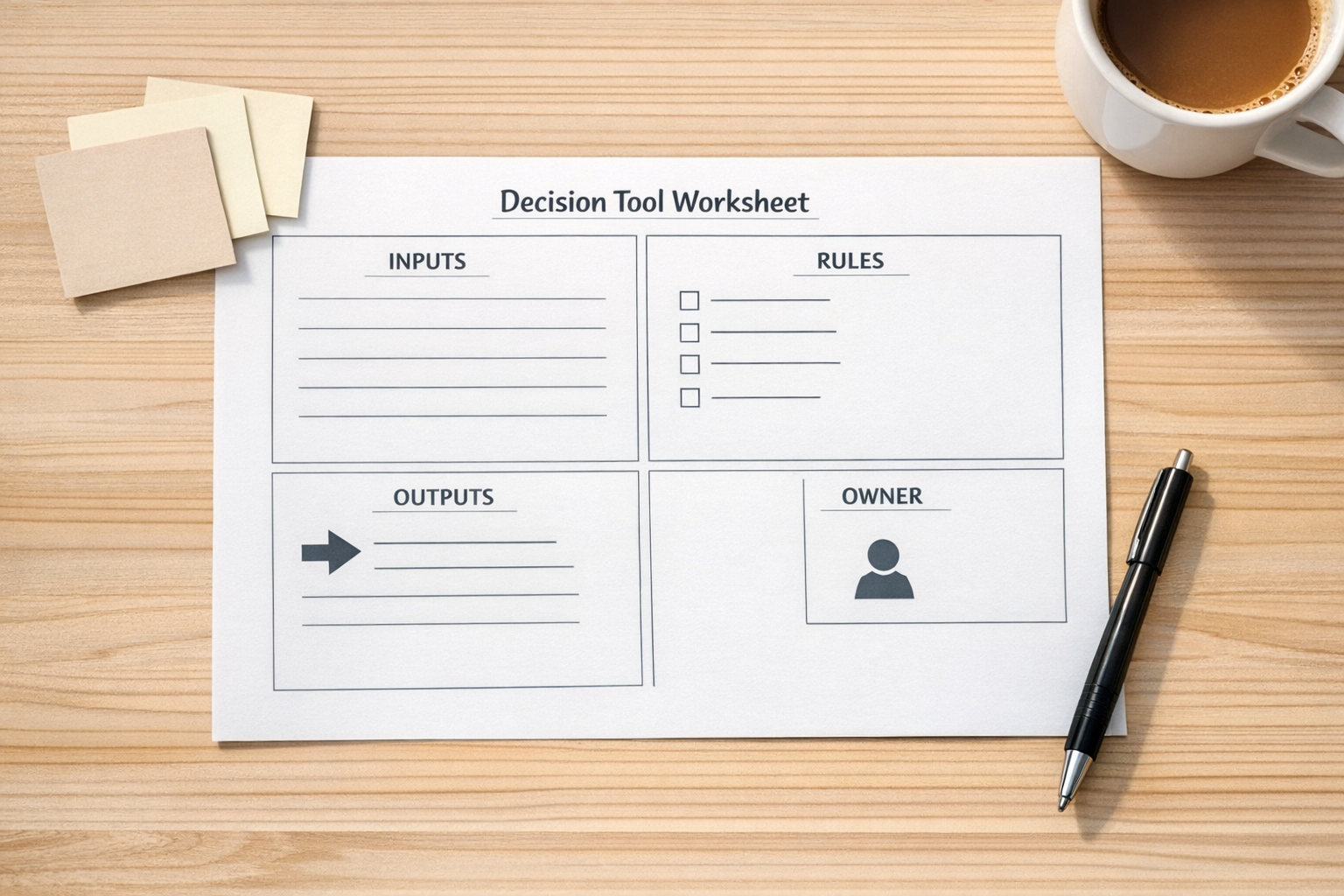
When we help teams think through automation and internal tools, we usually want five pieces defined before building:
1. Input
What starts the process? This could be a CSV export, CRM list, form submission, Shopify order, support ticket, ClickUp task, or scheduled report.
The input needs to be predictable. If the fields change every time, the tool will break or produce unreliable outputs. This is why workflow validation matters before automation.
2. Rules
What logic should be applied every time?
This may be a calculation, filter, matching rule, scoring model, date range, status condition, or routing rule. The important part is that the rule is visible. If someone asks why a lead was prioritized or why a task was flagged, the answer should not be “because the system said so.”
3. Output
What should the operator see or do?
A useful output may be a short list, a status update, a task assignment, an exception report, or a next-action recommendation. Avoid building outputs that look impressive but do not change behavior.
4. Owner
Who checks the result?
Automation still needs ownership. If nobody owns the output, the system becomes noise. A good workflow makes it obvious who is responsible for reviewing, approving, correcting, or acting.
5. Exception handling
What happens when the data is missing, duplicated, outdated, or unusual?
This is where many automations fail. They are built for the happy path only. Real operations need a place for edge cases, unclear records, and human review.
Where AI fits well
AI can be very helpful in the planning and build stage. It can help turn a messy process into a clearer specification. It can suggest logic, draft formulas, generate a first version of a script, outline a Make or Zapier workflow, or help structure a validation checklist.
But that does not mean every recurring decision should be made live by an AI model.
For many operational workflows, fixed logic is better. It is easier to test, easier to explain, and easier to maintain. AI helps you get there faster, but the final workflow should be dependable.
A practical setup might look like this:
- Use AI to map the process and identify edge cases
- Define the required fields and decision rules
- Build a lightweight internal tool, spreadsheet model, or automation
- Test it against real historical examples
- Document what the tool does and what it does not do
- Add human review where judgment is required
An operational example

Imagine a team that reviews new CRM leads every morning. Right now, someone exports the list, removes duplicates, checks whether each lead has a phone number, looks at the source, guesses priority, and assigns follow-up tasks.
That is a perfect candidate for a repeatable decision workflow.
The team could define:
- Which CRM fields are required
- What makes a lead incomplete
- What makes a lead high priority
- Which owner gets assigned based on region, service, or source
- Which records need human review
- What task should be created in ClickUp or the CRM
AI can help draft that logic and identify missing conditions. Then the workflow can be built in Make, Zapier, HubSpot, GoHighLevel, ClickUp, or another system the team already uses.
The result is not a flashy dashboard. It is something more useful: fewer manual checks, fewer inconsistent decisions, and a clearer handoff between marketing and sales.
Before you buy another tool
There are many good analytics and automation platforms. But not every problem needs another subscription.
Sometimes the real issue is that the decision process is not defined. The team has data, but no shared logic. They have reports, but no agreed next step. They have automation ideas, but no validation of the workflow underneath.
That is why process comes before tools.
If a recurring decision is important, document it. If the data is exported repeatedly, standardize it. If the same rules are applied manually, automate them carefully. If judgment is required, keep a human in the loop.
AI can speed up this work, but clarity is still the foundation.
How ConsultEvo can help
At ConsultEvo, we help teams turn messy operational processes into practical systems. That may mean CRM cleanup, ClickUp structure, Make or Zapier automation, HubSpot and GoHighLevel workflows, Shopify operations, AI agents, or internal tools that reduce copy-paste work.
If your team has a recurring spreadsheet, export, or report that drives a real decision, it may be worth turning it into a repeatable workflow.
Start with the decision. Validate the process. Then build the tool.