


AI content strategy works better before the draft
Many teams start using AI for content at the writing stage. They ask for post ideas, outlines, captions, newsletters, scripts, or full drafts. That can be useful, but it often creates a hidden operations problem.
Now there are more drafts to review. More half-good ideas to clean up. More content that sounds acceptable but does not really say anything useful. The bottleneck moves from writing to deciding.
A better use of AI is earlier in the workflow: idea validation before production.

This is especially useful for founders, consultants, agencies, and operator-led teams. You already have raw material everywhere: client calls, sales objections, delivery lessons, support tickets, internal notes, project retrospectives, and repeated questions from prospects. The challenge is not finding something to say. The challenge is knowing which ideas deserve time.
Do not turn AI into a content factory too quickly
When AI is used only to produce more content, it can increase the amount of work around content. Someone still has to check accuracy, remove vague language, make it sound like the business, and decide whether it is worth publishing.
That is why the role of the AI matters. Instead of treating it as a writer first, treat it as a filter.
Its job can be to challenge the idea, not just expand it.
For example, you can give AI a rough note like this:
“Clients keep asking whether they need a new CRM, but usually their current CRM is just messy.”
A basic content prompt might ask AI to write a LinkedIn post. A better validation prompt would ask:
- Who is this idea most relevant for?
- What operational pain is underneath it?
- What would make this idea more specific?
- What examples should be included?
- What claims should we avoid unless we have proof?
- What is the one useful takeaway?
Now the AI is helping you decide whether the idea is ready. That is a very different workflow.
A simple content validation framework
Before a content idea becomes a draft, run it through a basic validation page. This does not need to be complicated. In fact, the simpler it is, the more likely your team will use it.
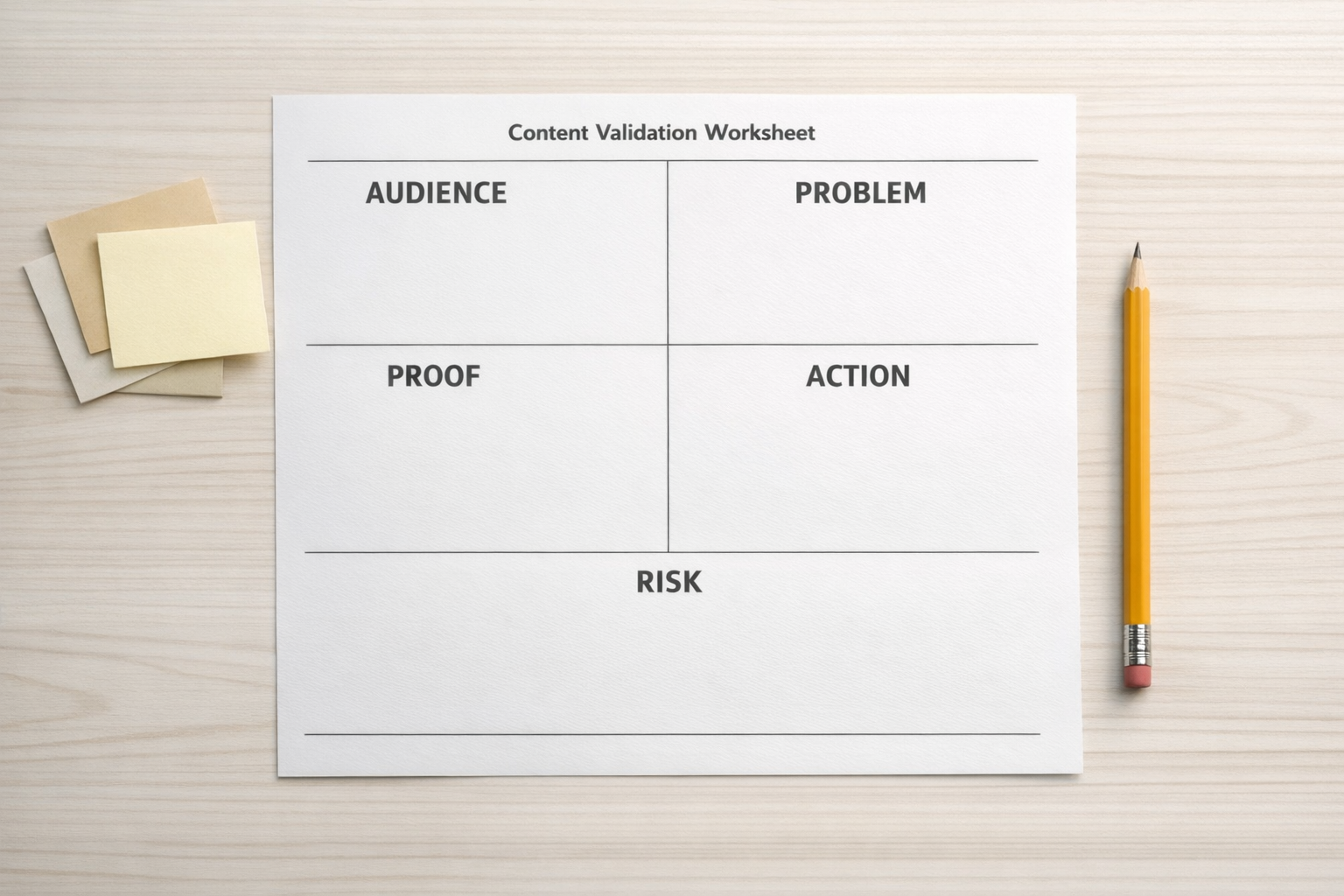
1. Audience
Who is this for? Not in broad terms like “business owners” or “marketers.” Be more concrete. Is it for a founder who is still handling operations manually? A sales team with messy handoffs? An agency owner trying to standardize delivery? A Shopify operator dealing with repeated fulfillment questions?
If the audience is vague, the content usually becomes vague too.
2. Problem
What real friction does the idea address? Good content often comes from repeated operational pain: copy-pasting between tools, unclear ownership, inconsistent follow-up, poor CRM hygiene, duplicate tasks, or workflows that only one person understands.
If the problem is not clear, the content may be interesting but not useful.
3. Proof
What experience supports the idea? This does not mean inventing statistics or making big claims. It can be a pattern you have seen, a common mistake, a lesson from implementation work, or a before-and-after observation from your own operations.
The safest and strongest content usually comes from things you have actually seen.
4. Action
What can the reader do after reading? This could be a checklist, a question to ask their team, a step to review in their CRM, or a small workflow improvement. If there is no action, the idea might be better as a note than a published piece.
5. Risk
What could make this content weak? Maybe the idea is too broad. Maybe it sounds like everyone else. Maybe it depends on a claim you cannot support. Maybe it needs a clearer example.
AI is useful here because it can be asked to critique the idea before you spend time producing it.
Where this fits in a real content workflow
An AI-assisted content workflow should not begin with “generate content.” It should begin with collecting real inputs.
A practical workflow might look like this:
- Capture: Save raw ideas from calls, notes, support conversations, project work, and internal discussions.
- Cluster: Use AI to group similar ideas and identify repeated themes.
- Validate: Score ideas against audience, problem, proof, action, and risk.
- Select: Choose only the strongest ideas for drafting.
- Draft: Use AI to help structure the piece, but keep the point of view human.
- Review: Check accuracy, tone, specificity, and usefulness.
- Publish and learn: Track what resonated and feed those lessons back into the idea bank.
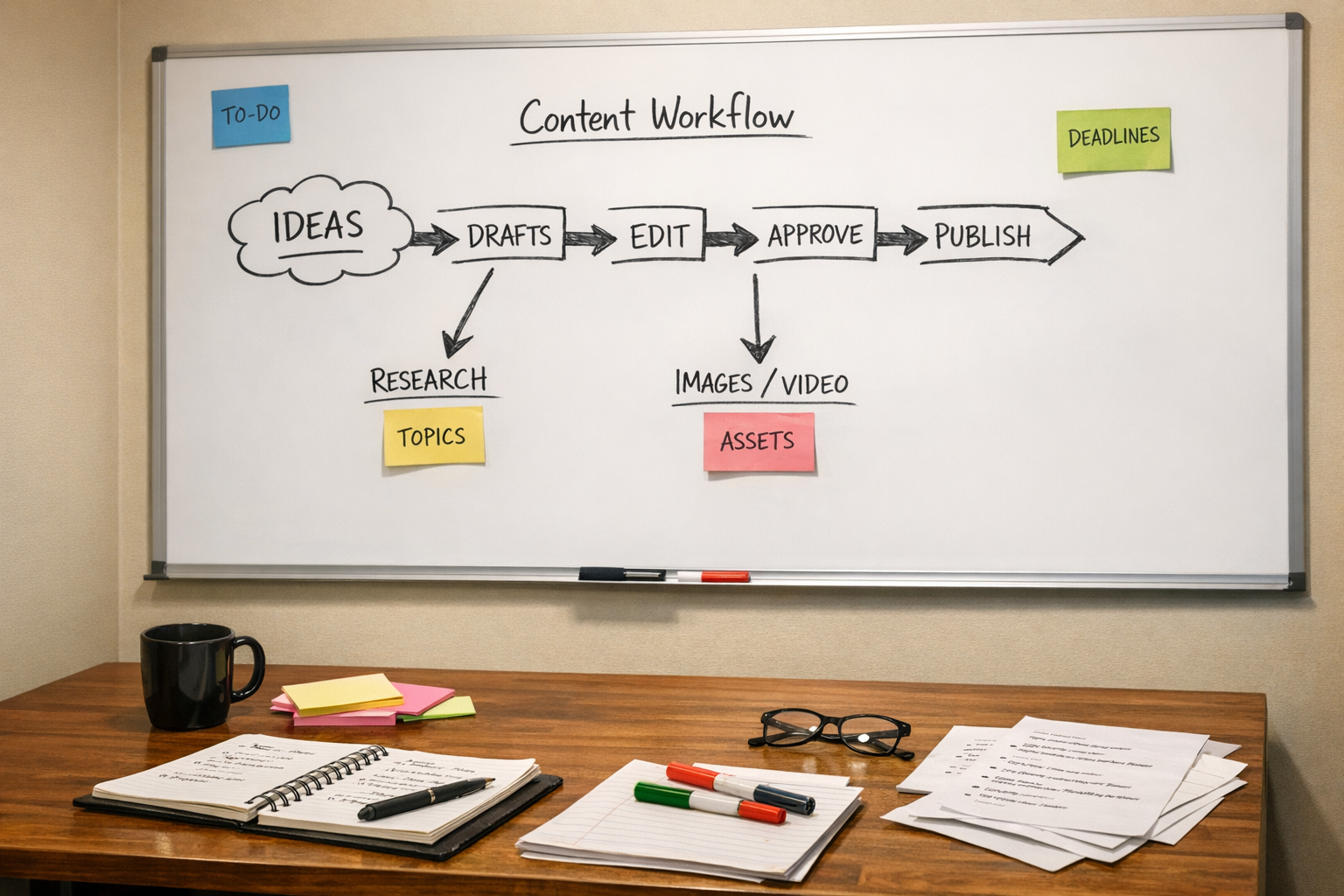
This creates a calmer process. You are not asking AI to create endless output. You are using it to reduce weak inputs.
The same principle applies to operations
This is not only a content lesson. It is an automation lesson.
AI agents, Make scenarios, Zapier workflows, CRM automations, ClickUp structures, and sales handoff systems all work better when the process is clear before the tool is added.
If the workflow is messy, AI often makes the mess faster. If the workflow is clear, AI can remove real work.
For content, that means validating ideas before writing. For CRM, it might mean cleaning lifecycle stages before adding automation. For sales, it might mean defining handoff rules before building notifications. For support, it might mean deciding what should be answered automatically and what should be escalated to a person.
The pattern is the same: define the decision points first, then add the system.
A useful prompt to start with
Here is a simple prompt you can adapt:
“Act as a practical content operations reviewer. I will give you raw content ideas from our business. For each idea, assess the audience, problem, proof, actionability, and risk. Do not write the post yet. Help me decide whether the idea is worth developing, what angle is strongest, and what information is missing.”
That one change can improve the quality of everything that follows.
Build the workflow before scaling output
AI can help you publish more, but more is not always the first goal. For many teams, the better goal is fewer weak ideas, clearer decisions, and less manual review.
When AI becomes part of a defined validation workflow, it stops being another content generator and starts becoming an operational assistant.
If you want help designing an AI-assisted content, CRM, sales, or operations workflow, ConsultEvo can help map the process, choose the right automation points, and build the system around how your team actually works.