


How to Build an AI Sales Engine Without Automating Confusion

An AI sales engine sounds simple from the outside. A lead comes in, AI reviews it, the CRM updates, follow-ups are drafted, tasks are created, and salespeople get better context with less manual work.
That is a useful goal. But the teams that get the most value from sales automation usually do one thing before they touch the tools: they define the process.
If the existing sales workflow is unclear, AI will not make it clear. It will usually make the confusion move faster. You may get more drafted emails, more tasks, more CRM updates, and more notifications, but not necessarily better sales execution.
A good AI sales engine is not just a collection of prompts and automations. It is a set of operational decisions turned into a repeatable workflow.
Start With the Work You Want to Remove
The best starting question is not “Which AI tool should we use?” It is: What work should no longer require a person?
In many sales teams, the obvious candidates are small admin tasks that happen many times per week:
- Reviewing inbound form submissions
- Copying lead details from one tool into another
- Checking whether a lead is already in the CRM
- Writing the first follow-up message
- Creating a sales task after a booked call
- Updating a deal stage after a response
- Summarizing a conversation for the next person
None of these tasks look huge by themselves. Together, they create drag. They slow down response times, make CRM data inconsistent, and leave salespeople doing work that does not require sales judgment.
That is where AI and automation can help, but only after the business defines the rules around the work.
Map the Sales Motion Before the Automation
Before building an AI sales workflow, map the current sales motion in plain language. Keep it simple. You are not trying to create a beautiful diagram. You are trying to find the decisions that the automation will need to follow.
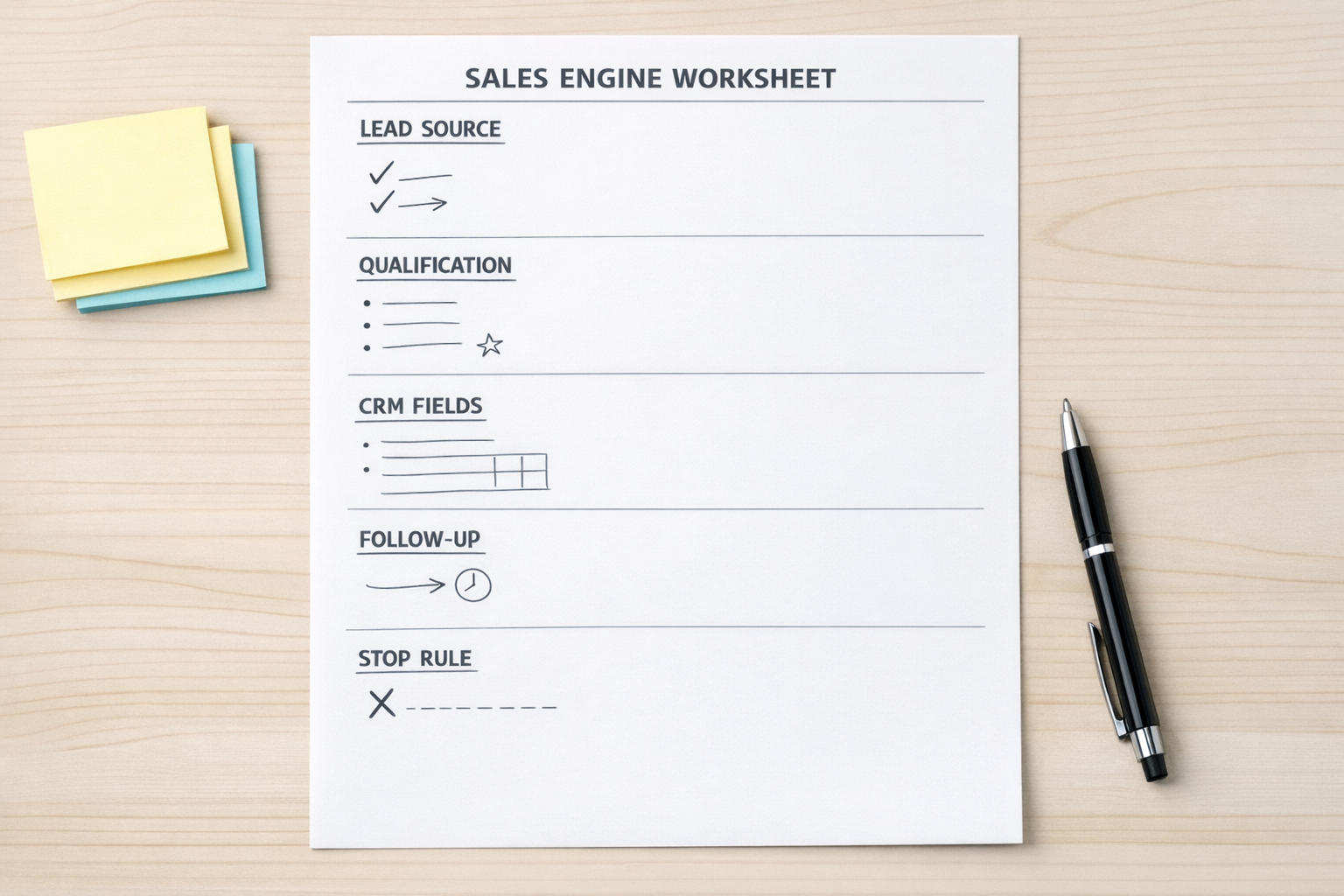
A practical worksheet should answer five questions:
- Where does the lead come from? Website form, ad campaign, referral, webinar, marketplace, inbound email, or another source?
- What makes the lead qualified? Budget, service interest, company type, location, urgency, existing tech stack, or another signal?
- Who owns the next step? Sales rep, founder, account manager, support team, or an automated sequence?
- What should happen next? Create a deal, send a reply, assign a task, request more information, or mark as not ready?
- When should the workflow stop? After a reply, after a booking, after a disqualification, after a certain number of follow-ups, or after a manual review?
These answers become the operating logic for the sales engine. Without them, the automation has to guess. Guessing is where messy CRM records and awkward follow-ups come from.
Decide What AI Should and Should Not Do
AI is helpful when the task involves interpretation, summarization, or drafting. It is less helpful when the underlying business rule is missing.
For example, AI can summarize a lead’s message and identify likely intent. But it should not invent your qualification criteria. AI can draft a follow-up email. But it should not decide your sales policy. AI can suggest a CRM stage. But your team still needs a clear definition of each stage.
A practical AI sales engine might include:
- Lead classification: AI reviews inbound text and labels the lead by service interest or urgency.
- CRM cleanup support: Automation checks for missing fields and creates a task to complete them.
- Follow-up drafting: AI prepares a first response for human review or sends it if the rules are low-risk and approved.
- Call preparation: AI summarizes CRM history before a sales conversation.
- Handoff notes: AI creates a short summary when a lead moves from sales to delivery or support.
The goal is not to remove human judgment from sales. The goal is to protect human attention for the moments where it matters.
Build the Smallest Useful Version
One common mistake is trying to automate the entire sales process at once. That usually creates too many edge cases, too many exceptions, and too much debate.
A better first version is narrow:
- One lead source
- One CRM pipeline
- One qualification path
- One follow-up workflow
- One clear handoff point

For example, you might start with website demo requests. The automation checks whether the contact already exists, creates or updates the CRM record, classifies the request, drafts a response, assigns an owner, and creates a follow-up task if there is no reply after a set period.
That version is small enough to test. It also creates a feedback loop. You can see where the AI classification is useful, where the CRM fields are incomplete, and where salespeople still need more context.
Validate the Workflow With Real Leads
Sales automation should be validated with real operational behavior, not just a clean test scenario. Before relying on the workflow, run a review period.
Check questions like:
- Are leads being assigned to the right person?
- Are CRM records cleaner than before?
- Are follow-ups happening at the right time?
- Are salespeople editing the AI drafts heavily?
- Are any leads getting stuck without an owner?
- Are disqualified leads being handled properly?
This is where many automation projects become valuable. The build exposes the unclear parts of the business process. Once those are visible, the workflow can be improved.
The Real Win Is Operational Clarity
An AI sales engine is not valuable because it sounds advanced. It is valuable when it removes repeatable work, improves follow-up consistency, and gives the sales team better context.
That requires operational clarity first. Lead stages need names. Ownership needs rules. CRM fields need purpose. Follow-up timing needs decisions. Handoffs need structure.
Once those pieces are in place, tools like Make, Zapier, HubSpot, GoHighLevel, ClickUp, and custom AI agents can do useful work. Without those pieces, the tools are just moving uncertainty from one system to another.
At ConsultEvo, we help teams design and build practical sales and operations workflows around the way the business actually runs. If your sales process depends on manual copy-paste, scattered notes, unclear follow-up, or messy CRM data, the best starting point may be a simple workflow review before adding more automation.